
Stray Image

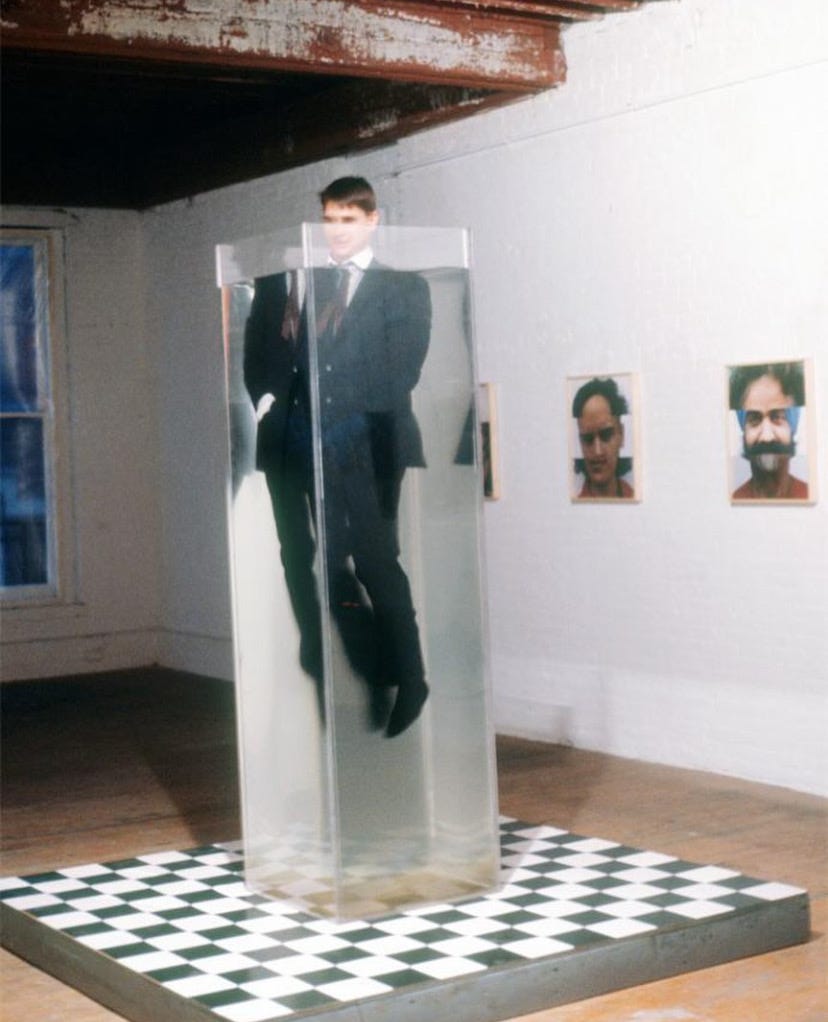
To me, there exists a poor image and what I wanna call the stray image. Hito Steyerl’s poor image refers to low-resolution, heavily compressed digital images that lose quality and context as they circulate. The stray image, however, operates differently. It isn’t necessarily degraded, but it moves without its history. It’s detached from its original framework yet still compelling in its own right.
I came across a photo of Carter with no accompanying information, a common occurrence in the way images circulate through social media. But this time, I felt compelled to trace its origins. With only a first name and a year as clues, I had just enough to make the search feel possible.
A quick search led me to his website, though there was no information about this particular work. So, I reached out via email. Months later, I received an incredible response.
The performance, Ipsodefacto at The Kitchen in New York City was created by Kevin Carter, Tom McKinnon, and Paul Vandeborne in 1989. The performance featured a soundtrack by Wreak of Success, with Robert Fitzgerald, Rob Keay, and Kevin Carter. Ipsodefacto explored the complexities of multiculturalism at the time.
The tank later became part of a series of performances, which is where the image was documented, including Green Streets at Art in General and Root of Influence/Verify Your Understanding at Pat Hearn Gallery and MoMA PS1. In these performances, Carter, submerged in the tank, took part in an evolving linguistic experiment: language teachers arrived every hour to give him a lesson, but as he moved from one language to the next, he forgot what he had just learned. This process continued through eight different languages, leaving him with only fragmented information and memories of each.
Later, Carter created a new installation and performance titled Death of a Signature, in which he sold his identity as Kevin Carter to an art collector. The project included photographs, sculptures, videos, and an installation at Josh Baer Gallery in New York. He then buried all the elements of the exhibition in a glass tomb on the collector’s property in Princeton, NJ. This act marked the creation of his new identity, Carter Kustera, which coincided with his marriage to gallerist Anna Kustera.
NOW… The irony of the response and the way this image itself exists. The irony of Kevin Carter’s response lies in how his explanation mirrors the very nature of the stray image. The image I encountered was circulating without context, untethered from its origins, yet, as Carter’s response reveals, the performance it documents was itself an exploration of identity, fragmentation, and loss of meaning.
In Ipsodefacto and its later iterations, Carter performed within a water tank, repeatedly learning and forgetting languages, accumulating only fragments of knowledge. Similarly, the image of this performance had been severed from its history, drifting in the digital ether with only traces of its original meaning intact. The very act of tracking down its origins mimicked the struggle within Carter’s performance: an attempt to reconstruct something lost, knowing that only partial understanding could ever be recovered.
Further deepening the irony is Death of a Signature, in which Carter relinquished his own identity, burying the material evidence of his past and adopting a new name, just as this image had, in a way, shed its history. My search for the image’s origins was a reversal of his artistic act: while Carter deliberately erased and reinvented himself, I was trying to retrieve and reattach meaning to an image that had been set adrift.